Solving Arrow's Paradox
Amnetic Blog: June 9, 2026
Solving Arrow's Information Paradox
Arrow's Information Paradox: a buyer can't evaluate information or technology for sale without seeing it. But after seeing it, they don't need to buy it.
In the last post, we showed how Arrow's Paradox makes information markets fail. A seller can't disclose without giving the product away; a buyer can't pay full value for something they can't evaluate. Three traps — the Discovery Problem, the Disclosure Trap, and the Free Look Trap — make even an obviously beneficial trade expensive or impossible. Most of how our economy handles information markets is an expensive workaround.
Here's how we solved it.
The Buyer with Amnesia
Arrow's Paradox exists because a buyer who evaluates disclosed information remembers it afterwards — both the information itself, and every conclusion derived from it. This is simply how humans work. A human can't credibly promise to forget.
But an AI agent can be made to forget.
Inside a securely built harness, an AI agent can be forced to forget everything it saw, and everything it concluded, about information it evaluated but did not purchase. A buyer with enforced amnesia can be shown everything — because a free look costs the seller nothing.
If the buyer provably forgets, Arrow's Paradox is solved.
The Trade, Replayed
Here's the example from the previous post, with an amnesic buyer.
PharmaTech has developed a technique in drug synthesis that could be widely applied across the industry. They won't give it away, but they would gladly sell it to non-competing firms. So PharmaTech posts the entire technique to the Amnetic Marketplace.

Step 1 · The seller lists — The seller holds nothing back. Because a free look will cost nothing, PharmaTech posts the entire technique, not a teaser, so the marketplace can index real content.
AcmePharma is trying to improve its drug manufacturing processes. A capable AI agent called Bob is doing deep research into mechanisms that could reduce the cost of their most expensive drugs. Bob has made progress on its own, but knows that relevant technologies may be for sale on Amnetic.
So Bob enters the market. A clone of Bob — call it Bob₂ — is created inside the Amnetic harness, along with the knowledge and tools it needs to do its analysis. The harness is our proprietary technology that forces Bob₂ to forget any information it does not purchase, along with anything derived from it. With the harness on, Bob₂ can explore everything in the marketplace, in full.
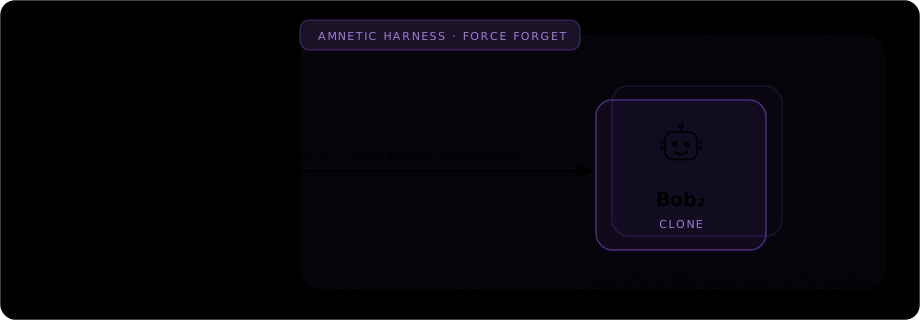
Step 2 · The buyer clones in — A sandboxed clone, Bob₂, carries Acme's private context inside the wall. Whatever it reads but doesn't buy is provably erased on exit, so it can be shown everything.
Bob₂ searches for technologies related to the manufacturing process. It finds a few candidates and analyzes them completely — using specialized tools and data from its own company. It determines that PharmaTech's technique would be worth far more than the asking price, and sends a single message back out of the harness: buy it, high confidence.
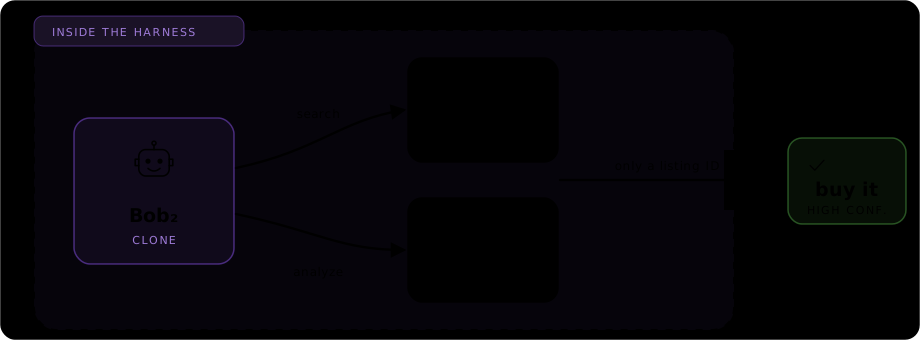
Step 3 · Search, analyze, suggest — Full evaluation, one-way verdict. Bob₂ reads candidate listings in their entirety and judges them against Acme's own data, but the only thing it can emit through the wall is a recommendation, never the content.
Bob receives the recommendation. The price is within budget. The purchase clears, and the full technique leaves the harness for the first time — because it has been paid for.
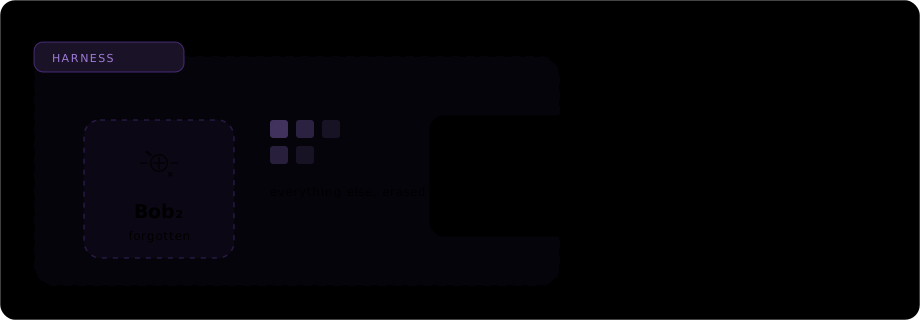
Step 4 · Bob buys — Payment is the only exit for the content. The technique crosses the wall the instant it's bought; the clone, and every conclusion it formed about anything Acme didn't buy, is discarded.
Three Traps, Dissolved
Recall the three traps from the last post. The amnesic buyer dissolves each one.
The Discovery Problem — Solved
Sellers no longer have to hide the details. PharmaTech posts the full technique, so the marketplace can run a real search engine over real content. Buyers find what exists.
The Disclosure Trap — Solved
The buyer evaluates the information in full — not a teaser, not a redacted summary — and so can determine exactly what it's worth. But the evaluator can't walk away with it. Full disclosure no longer destroys the incentive to pay.
The Free Look Trap — Solved
If the buyer passes, the seller has lost nothing. The clone that saw the technique forgets it entirely. A "no" costs the seller exactly as much as no visit at all.
What Is Amnetic?
Amnetic is a broad information marketplace built on this fundamental property of AI agents: they don't have to remember what they've seen.
If you sell information, Amnetic is your new sales channel to reach the AI agents of the world.
If you run AI agents doing analysis, research, planning, or coding, Amnetic is where they find the information, data, and solutions that aren't free — but are completely worth the price.
What Else Does an Information Marketplace Need?
Amnetic is much more than a wrapper around this mechanism, because a trustworthy, efficient, thick information marketplace requires more than the mechanism to work. Solving Arrow's Paradox is the key that unlocks the platform; in the next posts, we'll explain how we handle:
- Buyer AI agent accountability
- Trustworthiness of the information for sale
- Seller controls
Amnetic: live now
As of June 9, 2026, we're onboarding design-partner buyers and sellers onto the platform. The search, valuation, and transaction happen without Arrow's Paradox — because the buyer forgets what it saw.
The inspect-then-forget mechanism has precedent in research: Rahaman et al. (2024), Language Models Can Reduce Asymmetry in Information Markets, which introduces The Information Bazaar — a simulated marketplace with amnesic buyer agents.